Nearly half the world still cannot access the internet – let’s work together to solve this

What you’ll learn
- Global internet access has passed the 50% threshold, with 51% of the world's population now having access, led by Europe at nearly 80%, while only 25% of Africa's population has access and Asia Pacific is under 50%.
- The piece frames three barriers to closing the gap: technology/infrastructure (largely solved), spectrum/frequency access, and cost/business-model viability.
- On infrastructure, WTL's Vivada is positioned as offering complete access and core capabilities for even the most remote locations, self-contained enough to run off-grid and use satellite backhaul.
- On spectrum, the post calls for regulators to stop letting national licence holders sit on unused rights in remote regions, pushing instead for shared or open-access frameworks — noting regulators are increasingly opening access via innovative models, even without a one-size-fits-all approach.
- On cost, it argues connectivity needs a full ecosystem of bundled services (not just internet access alone) to be commercially viable, positioning WTL's Vivada partner ecosystem as the practical vehicle for that.
Access to the internet has grown, but there’s a long way to go. What’s needed to help close the gap and bring the benefits of connectivity to more people, in the places where it’s needed?
According to the ITU, global internet access has passed the 50% threshold, with 51% of the world’s population now enjoying access. Europe has led the way, with nearly 80% being able to access the internet – but success in this region masks problems elsewhere.
For example, only 25% of the population has access in Africa, while in Asia Pacific, the total is less than 50%. Data for Latin America are included in an overall total for the Americas, but it’s likely that there is considerable difference between North and South America.
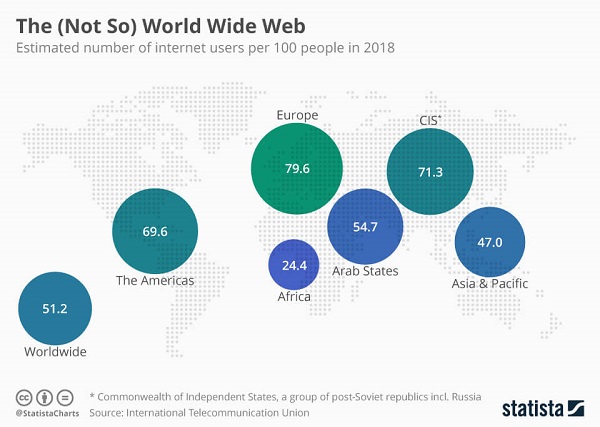
So, we have a long way to go before even a significant majority of the population secures internet access. Progress has been made, but it remains slow. This matters, because the internet is its users.
Several things are needed to change the situation and to bring internet access to those who need it. First, technology and infrastructure. This problem is largely solved – for example, WTL’s Vivada offers complete access and core capabilities, allowing services to be delivered in even the most remote locations. It is self-contained, so can be deployed off-grid and can also use satellite for backhaul. With solutions like this, there are few areas that are really impossible to reach.
Second, frequency and spectrum access. This requires concerted action at national and international level to shape policies and to enable either spectrum to be shared or for open access to be enabled. National license holders that do not intend to deploy coverage in remote regions cannot simply sit on spectrum rights. They need to be made available to others, via an equitable framework.
Happily, national regulators are beginning to see the benefits of opening access via innovative models. There isn’t a one-size-fits-all approach but the basic principle of opening up access is rapidly gaining support.
Third, costs. While there have been funds available to help, what really matters is ensuring that there is a business model that can be exploited in order to make such deployments commercial propositions. In turn, this requires several factors to be aligned. The price of the solution is important, but so too is the value of services that can be delivered. While internet access per se is the goal, offering voice and other communications services is essential as is enabling the infrastructure to support other services.
A broad approach is required that enables multiple services to be offered via new infrastructure – which demands an ecosystem of providers. And, this is perhaps the most important element of our Vivada solutions. We have carefully created an ecosystem of partners that add incremental value and allow maximise the potential of deployments.
If you have a project for connecting the unconnected but you’re struggling to build the business case, why not talk to our experts? We can show you how to blend services, reduce costs and enhance value, through our Vivada connected ecosystem.
Talk to us today to help solve connectivity issues and connect more people to the internet.
Share this post